

Uncategorized
How PMRobotics optimizes the production of drones with SLS-printed functional parts and tools

Feb
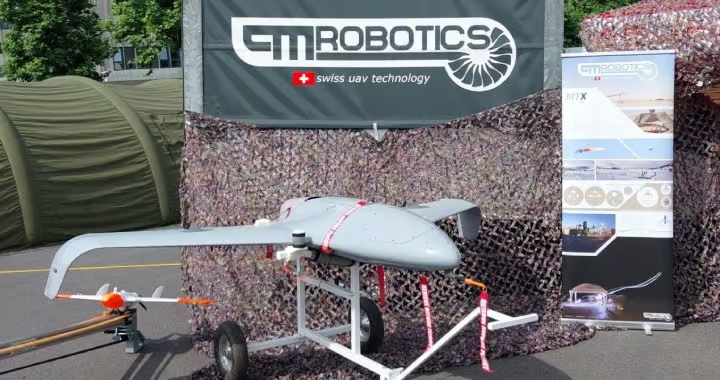
PMRobotics GmbH is a manufacturer of highly professional unmanned aerial systems. These consist of drones, data links, ground stations and launchers. In order to be able to offer the highest quality, fast customization options and comprehensive service, the company takes care of all steps from development to production and assembly through to flight operations.
Since the beginning, the company has used 3D printing as an important addition to CNC milling and cutting robots. This allows prototypes, end applications and equipment to be produced. Today, the team can not only produce autonomous, customized target display drones for functional tests of air defence systems, but also process special orders from various sectors such as the automotive industry – all with just six employees.
Find out from co-founder and designer Niklas Hagen how PMRobotics used 3D printing to reduce the development time of their new drone from the original nine months and two years to two years. You can also find out how the company manufactures operating resources for machines and revives classic cars in the motorsport sector.
Long-term success through organic growth
Niklas Hagen is particularly proud of the fact that his team is completely independent in the production of drones. From the electronics board to the autopilot, the aerodynamics and software through to the chassis, all components are “really 100% developed, designed and produced in-house,” explains Hagen.
The fact that PMRobotics GmbH can handle this wide range of tasks with just six employees is thanks to its consistent focus on organic growth. This focus was clearly dictated by the high labor costs in Switzerland, which led to an increase in productivity through machine support. Through low staff turnover and continuous investment in machinery, PMRobotics has built up both expertise and in-house production capacity. As a result, the company is now able to flexibly and efficiently carry out a wide range of productions.
“Our main focus is always on saving working hours. I always opt for an automated option so that I don’t have to hire staff who may no longer be needed once the job is complete,” says Hagen.
Webinar
Discover how the Fuse 1+ 30W is transforming the manufacturing value chain with record-fast production of high-performance SLS parts.
Language: German
View nowWhen SLS printing became affordable – Improved efficiency through in-house manufactured prototypes, consumables and end applications
Before the introduction of 3D printing, Niklas Hagen’s team had to painstakingly design the numerous adaptations required for completely in-house production by hand. This led to long development and production times as well as high personnel costs. “In the past, for example, we had to assemble small, complex bracket constructions made of milled wood parts and fiberglass for our CNC milling machine. We had an incredible number of such assemblies that had to be assembled or where holders had to be glued together from small parts,” he recalls.

PMRobotics GmbH is driving forward the internal production of individual fixtures and operating equipment by using the Fuse 1+ 30W and Fuse Sift to optimize production.
Shortly after its founding, the PMRobotics team realized that their quest for self-controlled, in-house development and manufacturing was not feasible without change. They found the solution in 3D printing, which allowed them to automate much of these tasks, reduce labor costs and accelerate product development through functional prototypes.
“The fact that we can produce prototypes and small functional parts with lots of details extremely quickly is what fascinated us about 3D printing. With 3D printing, we were able to completely eliminate the need for tinkering with prototypes and brackets. For us, 3D printing is absolutely indispensable.”
Niklas Hagen, Co-Founder & Designer, PMRobotics GmbH
Initially, PMRobotics only had a simple FDM (Fused Deposition Modeling) printer at its disposal. While FDM printing has hardly developed at all over the years, Niklas Hagen is enthusiastic about the maturing process of SLS (selective laser sintering) printing and the affordable acquisition costs for the Fuse 1+ 30W industrial SLS printer from Formlabs compared to the rest of the industry. “Not much has happened in the FDM sector in recent years, but the development in SLS has been extreme. When we started 3D printing nine years ago, it was unthinkable to have our own SLS printer in the workshop at this price,” explains Niklas Hagen.
It was therefore natural for the team to expand PMRobotics’ additive manufacturing capabilities with the Fuse 1+ 30W when it became possible “to have this technology for so little money,” says Hagen. After a visit to Formlabs’ Swiss partner 3D-EDU, the team was “very impressed with the quality of the printers, the design and the look of the parts,” he recalls. 3D-EDU not only provided support in the selection and implementation of the optimal 3D printer, but has also provided the company with comprehensive service ever since.
By introducing SLS printing, PMRobotics was able to significantly optimize the production of operating resources. Because “with the Fuse [1+ 30W], many more application possibilities were added. Be it adapters for vacuum hoses [of vacuum tables], holding gauges, production gauges, production equipment, aids, brackets or small details on our CNC machines,” says Hagen. He is also impressed by the fact that with SLS 3D printing, unlike FDM, he can now print parts that “don’t obviously look like 3D printing, but look professional and clean”. As a result, his team now uses 3D printing not only for the production of tools and prototypes, but also for the production of end applications in small series without any problems.
Accelerated development time nosedive – drone development and production accelerated by 30% with functional SLS printing
The increase in PMRobotics’ productivity through SLS printing is illustrated by the example of the current target display drone. This drone had to be developed particularly quickly as it was already scheduled for use by a customer. The team was therefore under considerable time pressure in the final development phase, particularly because the large number of components had to be perfectly coordinated with each other, sometimes developed in parallel and in several iterations.
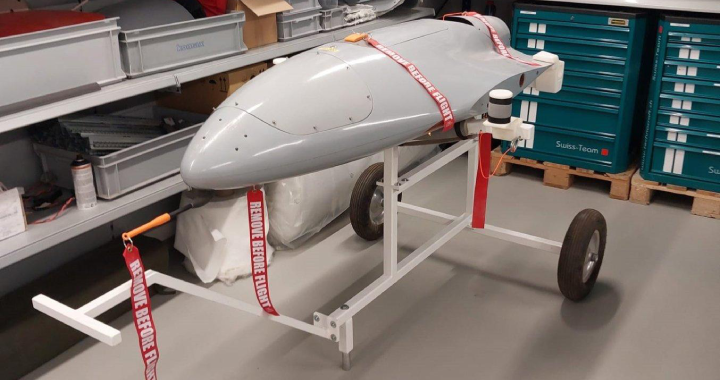
Development of PMRobotics drones accelerated by 30% through the use of SLS printing.
Previously, these iterations significantly slowed down the PMRobotics team’s development processes, as printed plastic prototypes were sourced from external service providers and they had to wait an average of four days for delivery. This resulted in a longer time to market for their drones and jeopardized meeting project deadlines in specific cases.
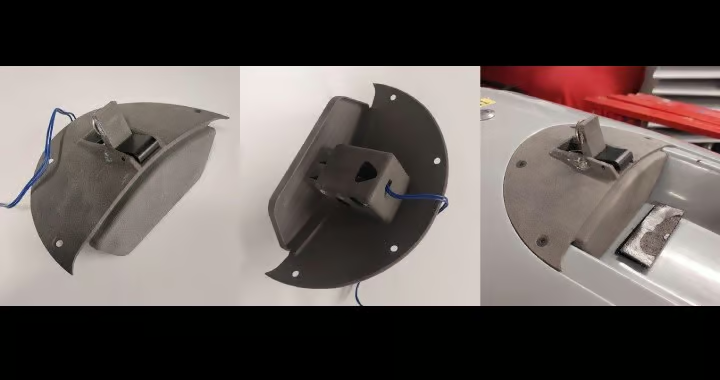
PMRobotics manufacture all plastic components for their drone using SLS printing.
On the other hand, the Fuse 1+ 30W enabled the team to print several interdependent parts simultaneously overnight due to its large build space. This allowed the employees to use their working time efficiently the next day for any necessary conceptual adjustments and to continue development almost without interruption. The reduction in waiting times by external service providers meant that PMRobotics was able to reduce the overall development time of the drone by 30%.
“I adjusted the components three or four times in a week. The Fuse is extremely strong. By the time others have ordered and received the part, I’ve already customized it perfectly. Others need six or seven weeks for this and I’m finished in a week, thanks to the in-house process […] In total, I’ve saved three quarters of a year in development time compared to external deliveries.”
Niklas Hagen, Co-Founder & Designer, PMRobotics GmbH
| Without in-house 3D printing | In-house 3D printing | Time savings through 3D printing | |
|---|---|---|---|
| Time-to-market drone | 2 years and 9 months | 2 years | 9 months or 27 % |
| Lead time / part | 4 days | 1 day | 3 days or 75 % |
In addition to the iterative design process, PMRobotics used the SLS 3D-printed parts for all plastic components in the final drones, which it produced for the customer in a small series of eight. Thanks to the good print and material quality of the Fuse 1+ 30W and the nylon 12 GF powder used, the final development phase was able to move seamlessly into the production phase. During this phase, the 3D printer ran “almost continuously every day, with large print jobs and a 30 percent filling level,” explains Hagen.
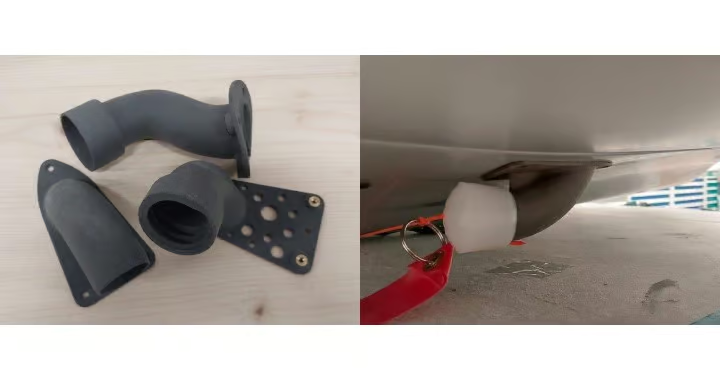
In-house 3D printing means that prototype parts can be produced overnight and adapted quickly instead of having to wait several days for delivery.
Niklas Hagen uses the functional 3D prints to immediately use components for customer applications and to continuously optimize them. Until all design errors have been corrected and the components are manufactured externally in large series, the parts from the Fuse 1+ 30W are actively installed, sold and used in the field, he explains. Without the continuously built-up production capacity, the team would not have been able to complete the drones in time for customer use, which would have led to a loss of the order and reputation.

Guide
This comprehensive guide covers selective laser sintering (SLS) and the different systems and materials available on the market. It also explains the workflow with SLS printers and various applications of this technology.
Download PDF“Old love never rusts” – 75% cost savings for custom-made classic cars thanks to SLS printing
In addition to drone development, in-house SLS 3D printing opens up further sources of revenue for PMRobotics through the construction of affordable, customized end applications, for example in the automotive industry.
A passionate motorsport enthusiast recently wanted to breathe new life into his faithful Alpine V6. The classic car, which was manufactured until 1991, already had a noticeable lack of power at low revs, which is even greater today compared to modern competitors. The customer therefore turned to PMRobotics to optimize the classic car’s engine with a new intake manifold including injection systems with modern throttle valves. However, suitable spare parts or upgrades are rarely available for older cars. The team therefore had to design and manufacture the intake manifold themselves, taking into account complex geometries, tight tolerances, temperature and fuel resistance and the customer’s limited hobby budget.
Without the Fuse 1+ 30W, the designers would have had to resort to conventional processes such as milling or casting, which would have been time-consuming and too expensive for the customer due to the complex geometry of the intake manifold. By using the Fuse 1+ 30W, PMRobotics was able to reduce the cost of the intake manifold by 75% compared to milling. The classic approach with aluminum casting would have been “even more expensive because you have to produce molds and have the complex casting process and post-processing,” explains Hagen and adds: “3D printing has enabled an extremely clean part and the technically perfect solution. These many offsets and differences in shape can be printed without any headaches, and the transition and surface are perfect.”
For PMRobotics, Nylon 12 GF Powder has proven to be a truly universal solution, as it is used for their drone work or assembly aids as well as for the intake manifold. Niklas Hagen appreciates the high stiffness and fidelity to the CAD model of Nylon 12 GF Powder for the wide range of applications from “very massive parts to very fine constructions”. The versatility of the material allows him to leave it permanently loaded in the Fuse 1+ 30W, saving on cleaning and associated labor costs. For specific jobs that require other printing materials, he turns to 3D-EDU and its network for short-term support.
In the case of the intake manifold, the material also had to be resistant to high temperatures and chemicals. Without this, the part could dissolve, get into the engine and possibly cause engine damage, explains Hagen. As the intake manifold is used behind the fuel injection system, it is constantly exposed to engine heat and fuel vapors. Compared to an FDM part, the Fuse 1+ 30W enables a nice, homogeneous material with sufficient temperature stability and is also petrol-resistant, he emphasizes.

The 3D-printed intake manifold made of nylon 12 GF withstands the high temperatures and chemical stresses in the engine over the long term.
Thanks to the low unit costs of SLS printing, Niklas Hagen can profitably process customer orders such as this one, where he usually has to produce individual items within tight budgets. This opens up additional sources of revenue for PMRobotics. “This was very classic, exemplary customer work, a special order. You only need one piece. Of course, the Fuse 1+ 30W is ideal for implementing this,” says Hagen.
With in-house SLS 3D printing, Hagen’s team can not only replace expensive conventional or manual processes for prototyping and end applications, but also optimize the use of its machinery.
Equipping the large number of machines used with suitable operating resources and spare parts is a constant challenge for PMRobotics. With the Fuse 1+ 30W, employees print a wide range of equipment such as adapters for vacuum hoses, assembly holders and gauges for vacuum tables, CNC milling machines and cutting robots. This allows them to adapt the production systems flexibly and quickly to current projects, such as individual customer orders, reduce downtimes and cut personnel costs for the tedious search for inferior tools.
“With the Fuse 1+ 30W, I can solve many, many daily problems much more flexibly. For example, I have self-built vacuum tables with large air hoses for our KUKA robots. Instead of spending hours looking for a hose connection and then having to order it, I can design it myself in CAD and have my hose connection with quick-release fastener the day after, exactly as I want it,” explains Hagen by way of example.

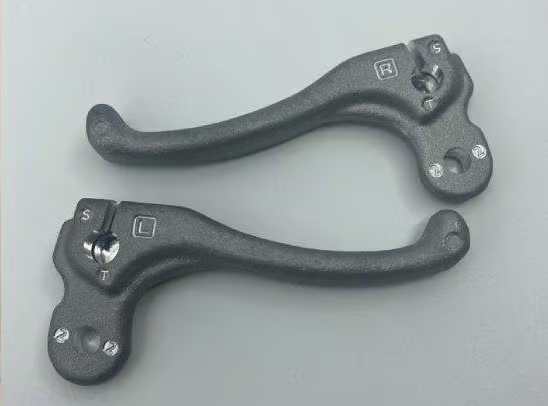
PMRobotics optimizes the use of its CNC milling machines for individual customer orders with custom-fit 3D-printed holders.
While the team previously had to make or have holders, gauges and drilling templates made by hand, it can now “simply print individual solutions more cheaply and, above all, more quickly”, which allows it to “work much more professionally, quickly and cleanly”, explains Hagen. Thanks to 3D printing, the team can reduce the manpower and costs involved in preparing for production, while at the same time optimizing the manufacturing quality of the expensive equipment.
Employees appreciate the ease of use and reliability of the Fuse 1+ 30W, especially for the quick preparation of productions with small printed aids. Thanks to the user-friendly interface, they can prepare prints quickly and with little risk so that they can use their working time productively for customer projects.
“The Fuse [1+ 30W] is the simplest printer we have. With FDM I have a lot more setup work, although the print is much less complex. The Fuse [1+ 30W] is really safe for the dumbest user. I can’t adjust anything, I can’t mess anything up. It really is almost like a paper printer. And that’s what I appreciate most about the Formlabs system: that it works simply and is stable.”
Niklas Hagen, Co-Founder & Designer, PMRobotics GmbH
Investing in future success with in-house 3D printing
For Niklas Hagen, it is incomprehensible that more manufacturing companies have not been using in-house 3D printing for a long time when he considers the wide range of applications that his team works on with the Fuse 1+ 30W. He regularly prints parts on behalf of a young automotive company that is converting diesel vehicles to electric drives and asks himself: “As an innovative company, why don’t they have a reasonably good printer?”
Hagen can only explain the fact that even larger companies are foregoing the benefits of 3D printing by a short-sighted corporate philosophy. In his opinion, many manufacturers are still underestimating the opportunities of additive manufacturing for fear of investment, even though they are enthusiastic about the quality of the printed parts.
“I recommend it to many people: You need to spend some money and then you’ll have a printer that runs plug-and-play and isn’t a hassle. But I often see that large or medium-sized companies shy away from the investment. Instead, they buy a 3D printer for 300 euros, some Chinese junk, to be honest.”
Niklas Hagen, Co-Founder & Designer, PMRobotics GmbH
Niklas Hagen and the PMRobotics team will remain true to their philosophy of steady growth in the future. They plan to continue to consistently invest in their production facilities and deepen their expertise. Thanks to this combination of expertise and modern equipment, they are currently being inundated with requests for drone development projects in the field of prototyping.
In addition, they plan to further develop their own drones, particularly in the area of small target imaging. Hagen is pleased that he and his colleagues can rely on functional prototype parts and resources from the Fuse 1+ 30W for these projects. They strive to stay innovative through continuous testing to see which parts they can successfully replace with 3D printing.


