

Medical
New materials for medical 3D printing: BioMed White Resin and BioMed Black Resin

Jun
Two new medical-grade materials for a wide range of functional applications
Formlabs recently introduced two new 3D printing materials for medical applications. The two SLA resins BioMed Black Resin and BioMed White Resin are now available from us. Both materials are opaque and intended for biocompatible applications.
Formlabs Medical sees the large selection of printing materials in stereolithography 3D printing (SLA 3D printing) as one of the greatest advantages of this process. Based on customer feedback, the Formlabs materials team has now developed two new resins. This is also intended to underline Formlabs’ commitment to medical innovation and the promotion of additive manufacturing in the healthcare sector. BioMed Black Resin and BioMed White Resin complement our range of biocompatible printing materials. This opens up new opportunities for medtech companies and the healthcare sector in general.
In this article, we explain how these new materials promote flexibility and innovation in medical 3D printing.
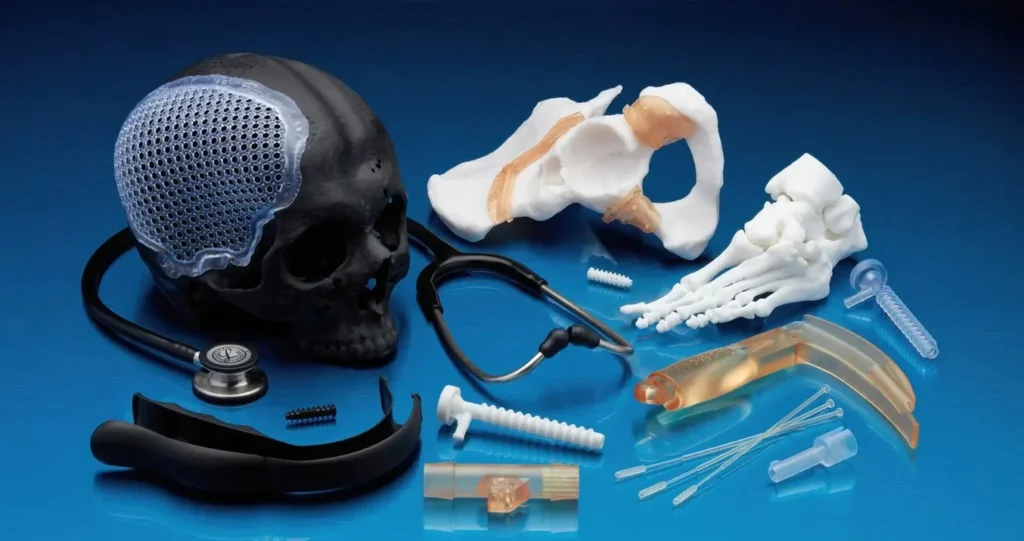
Use a wider range of 3D printing materials for biocompatible applications
We introduced the first medical 3D printing materials BioMed Amber Resin and BioMed Clear Resin in 2020. This was the first time Formlabs SLA 3D printers(Form 2 and Form 3B(+)) could use medical-grade functional materials to produce innovative, biocompatible devices and products. Since then, more and more new medical devices have been produced using additive manufacturing for end-use parts. Based on current trends, patient-adapted devices will be the most common application. Along with the growth of point-of-care manufacturing, the demand for personalized surgical instruments and devices is also expected to increase.
Formlabs BioMed Black and BioMed White Resin are designed to support these trends in the medical industry:
Both materials are suitable for biocompatible applications.
BioMed Black Resin is an opaque matt black material. Components made of BioMed Black can be used for long-term skin contact or short-term contact with mucous membranes. This medical material is also suitable for applications that require high contrast for visualization. In addition, the material reproduces details excellently and has a very high surface quality.
BioMed White Resin is an opaque white material. Components made of BioMed White are suitable for long-term contact with the skin or short-term contact with mucous membranes. In addition, this medical material is validated for short-term contact with tissue, bone and dentine.
Material properties
|
Long-term skin contact |
Short-term mucosal contact |
Long-term contact with mucous membranes |
|
|---|---|---|---|
| BioMed White Resin |
✅ |
✅ |
Not evaluated |
| BioMed Black Resin |
✅ |
✅ |
Not evaluated |
| BioMed Amber Resin |
✅ |
✅ |
Not evaluated |
| BioMed Clear Resin |
✅ |
✅ |
✅ |
The physical and esthetic properties of BioMed Black Resin and BioMed White Resin offer numerous advantages:
- Better visualization: As part of diagnostic and surgical planning, doctors use coloured materials for surgical instruments. This is because these form a stronger contrast to other components, soft tissue or the surroundings. In pharmaceutical production, for example, black and white prints can increase the contrast between powders or solids and colored parts. This can support efficient work processes. In addition, these new materials deliver high-quality, finished-looking products. This increases acceptance and makes it easier for doctors and/or patients to comply with regulations.
- Minimize complications: With 3D printing of medical materials, you can produce parts and assemblies that adapt to the organic shapes of the human body. The smooth surfaces reduce the available surface area for microbial adhesion. This reduces the risk of microbial growth and unnecessary friction in the end-use parts.
The opaque resins BioMed Black Resin and BioMed White Resin not only have aesthetic properties, but also block and absorb additional light. This property must be taken into account when 3D printing parts for heat- and light-sensitive applications. With our expanded range of biocompatible materials, the medical community now has access to materials that match their current applications. Each material has different functional advantages.
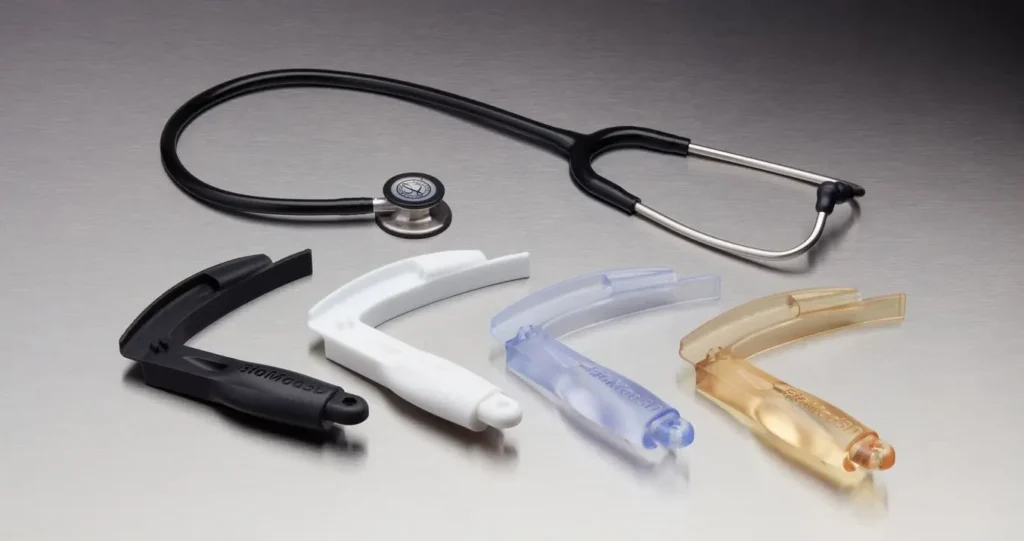
| material | Application examples |
|---|---|
| BioMed White |
|
| BioMed Black |
|
| BioMed Amber |
|
| BioMed Clear |
|

Formlabs BioMed White Resin is USP Class VI, ISO 10993 and USP <151> certified. This makes the material ideal for surgical drill guides and templates in oral and maxillofacial surgery, orthopaedics and neurosurgery. Combined with the reliable performance of the Formlabs Form 3B+ SLA 3D printer, the guides can be produced easily and efficiently at the point of care. In this way, patient-specific medical devices can be produced in a decentralized manner, independent of capital-intensive printers and materials. These solutions also contribute to a robust distributed healthcare supply chain.
Our BioMed resins are intended for healthcare professionals. All Formlabs BioMed resins are developed and manufactured in an ISO 13485 certified facility. BioMed resins are compatible with standard disinfection and sterilization procedures.
This allows medical device companies to use biocompatible parts to evaluate prototypes directly in beta or clinical trials. High-quality, smooth, biocompatible 3D-printed parts simulate your end product and allow the company to obtain accurate feedback. This means that patient tests can be carried out much more quickly and flexibly and the production of expensive injection-molded plastic parts can be dispensed with.
For hospitals and medical professionals, biocompatible parts are a driver of innovation in patient care. From implant templates and surgical guides to patient-specific surgical instruments and visual aids for diagnosis or teaching, Formlabs’ biocompatible materials are suitable for a wide range of biocompatible applications that require short-term skin or mucosal contact.
In addition, BioMed Clear Resin is unique in that it is ISO 18562 approved for use in healthcare airways. Like BioMed Clear Resin, the new BioMed Black Resin and BioMed White Resin are USP Class VI certified and suitable for pharmaceutical applications and drug delivery.
Get started with 3D printing for biocompatible applications
With the introduction of new QMS-compliant materials such as BioMed Black Resin and BioMed White Resin, Formlabs is taking a leading role in the healthcare 3D printing market. Both materials are available from today.
If you have any questions about these new materials or need help choosing the right material for your medical application, please contact us.

