

Dental
New: Formlabs IBT Resin – transfer splints for bracket placement

Mar
The new Formlabs IBT Resin simplifies orthodontic bracket placement. The new IBT Resin is suitable for the 3D printing of transfer splints for the indirect bonding technique. Together with other dental materials, such as Draft V2 Resin, Formlabs offers a wide range of 3D printing materials for orthodontic professionals that help save time, money and labor.
3D printing in orthodontics
As a result of the development of digital technologies, orthodontics began to change continuously over a decade ago. The widespread use of 3D printers to produce transparent aligners ushered in the age of customized dental applications for the masses. Treatments are becoming faster, easier and more comfortable for both dental professionals and patients.
Although the popularity of clear aligners is growing steadily, clear aligners have their clinical limitations. The discreet appearance of aligners appeals to both teenagers and adults. In addition, 3D printing enables the inexpensive in-house production of aligners. As a result, more and more patients can afford this treatment. However, traditional orthodontic treatment with braces is still the appropriate approach in many cases.
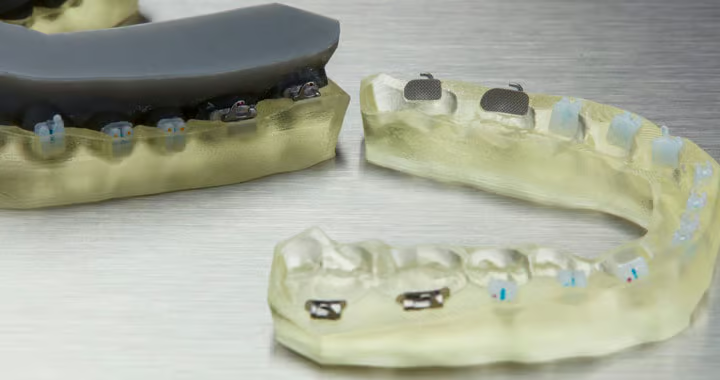
In this case, transfer splints from the 3D printer come into play. They can sometimes reduce the amount of work and costs involved in placing the brackets.
3D printer for easy bracket placement
A transfer tray (also known as an IBT – indirect bonding tray, or IDB) is an individualized dental fit that is precisely tailored to the patient’s dentition and bracket situation. This means that the entire set of brackets, including expanders, can be fitted in a single step. Thanks to the virtual planning of the placement in advance, the time spent in the treatment chair can be halved. This saves the orthodontist valuable working time.
Compared to other 3D printing materials for the production of transfer splints, Formlabs IBT Resin is more flexible, more tear-resistant and offers greater translucency. The transfer splints made of Formlabs IBT material are easy and time-saving to use during treatment.
This biocompatible Class I resin has been extensively tested by Formlabs and industry experts. It impresses with its precision, the printability of the material and the uncomplicated application during treatment.
What characterizes the Formlabs IBT Resin?
- The Formlabs IBT Resin has an improved coloration. This makes the brackets stand out more clearly from the teeth. Accordingly, the procedure is less complicated and allows less room for error.
- The finished transfer splints are odorless, tasteless and non-sticky. Accordingly, the procedure is not unpleasant for the patient.
- As only a minimum of support material is required for production, there is less waste and fewer reworking steps.
- Post-processing is easy and unproblematic because no glycerine or nitrogen is required for post-curing.
How do you work with IBT Resin?
Does your orthodontic practice or laboratory already work with digital tools? Then working with IBT Resin is very easy for you.
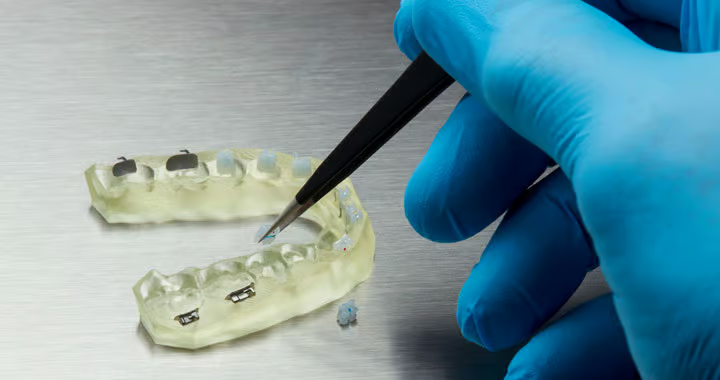
With an intraoral scan and a digital treatment plan, a 3D model of a transfer splint can be created in just a few minutes. An orthodontist, dental technician or assistant can use their preferred orthodontic design program for this. You then export the model in STL format. The file can then be imported directly into the Formlabs software and prepared for 3D printing with just a few clicks.
3D printing the part on a Formlabs SLA printer requires no additional handling. Once the printer is prepared with resin cartridge, resin tank and build platform and the 3D file is uploaded, the process is started with a single push of a button. No further intervention is then necessary.
After printing, the parts must be washed in at least 96% isopropyl alcohol and post-cured with UV light and heat. These steps can be automated with the Form Wash and Form Cure. The transfer splint can then be disinfected and processed with conventional orthodontic tools.
For a step-by-step application guide in PDF format, please feel free to contact us.


