

Engineering, Rapid Tooling
How the Swiss company Fri-Plast Engineering uses 3D printing to manufacture injection molds.

Aug
The mold was printed with Formlabs Form 3L and Rigid 10K resin
Using SLA 3D printers from Formlabs, the company from Giffers produces prototype tools for injection molding. Find out how successful, time-saving and cost-effective in-house production of injection molded components works.
Fri-Plast Engineering GmbH, based in Giffers/FR, is a service provider for product development, tool design & project management in the field of plastic applications. Founded in 2020, the company has more than 25 years of experience in the production, use, processing and finishing of plastics. Under the leadership of CEO Christian Poffet, plastics engineer FH/NDS and mechanical engineering designer HF, the company has always strived for innovation in order to realize the individual ideas of its customers in plastic.
The company has been using additive manufacturing for various applications since the beginning, enabling its customers to provide specific prototypes or special initial samples at every stage of a project. The technology also makes it possible to support customers in significantly shorter lead times.
Since 2021, they have been in possession of a MakerBot Method X, which enables the production of components in classic plastics such as ABS, ASA, PC or nylon 12 CF. This 3D printer is mainly used for prototyping. This is because it can be used to produce prototypes in the planned end material, which can be tested 1:1 for their function.
This was followed in February 2023 by the purchase of a Formlabs Form 3L, a large-format SLA 3D printer for high throughput. This expands Fri-Plast’s options for small series production in the injection molding sector. Using SLA printing, prototype tools for injection molding and for gripper construction in the automation sector (parts removal) can be printed and thus made available at low cost.
What is Rapid Tooling?
Rapid tooling is the name given to techniques for the fast and cost-effective production of tools for conventional manufacturing processes. Conventional tools consist of durable metal parts that are produced by machining or metal casting. Rapid tooling as part of product development allows manufacturers to validate their designs and materials before moving to mass production. This speeds up product development and enables rapid iterations, plus the final production materials can already be used. This allows the performance of parts to be evaluated in real-world applications or small batches to be used for beta and validation testing. Rapid tooling also helps with troubleshooting in the manufacturing process; errors in the tool are detected before investing in expensive production tools. In addition, rapid tooling offers the opportunity to produce customized or small batches of end-use parts using traditional manufacturing processes that would simply be prohibitively expensive with conventional tooling.
Use of SLA 3D printing for the production of injection molds
At Fri-Plast Engineering, the acquisition of the SLA 3D printer was always focused on the goal of producing tools for injection molding. The combination of additive manufacturing and injection molding should make it possible to implement and generate applications in short throughput times. This gives customers the opportunity to thoroughly test prototypes made from specific end materials during the development phase and, if necessary, to optimize them directly.
In this specific case, the aim was to produce a component in polyethylene PE-HE7541. A prototype tool for injection molding was created using the Formlabs Form 3L made of Rigid 10K Resin.
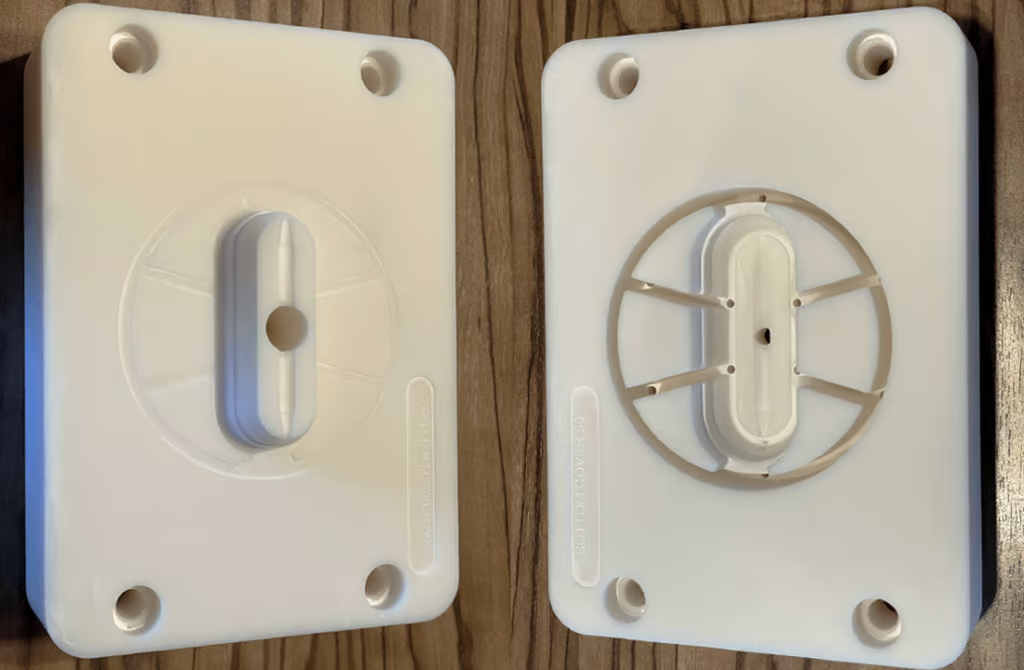
Injection mold produced using an SLA printer.
The challenge in this application was to design the tool in such a way that the customer could be provided with parts from the end material quickly and cost-effectively.
Furthermore, it was a first for the injection molder to work with a 3D-printed tool, as the entire process differs from the original method with steel tools. The quality of the tools was gradually raised to an optimum with several prints so that the injection molder could produce clean parts.
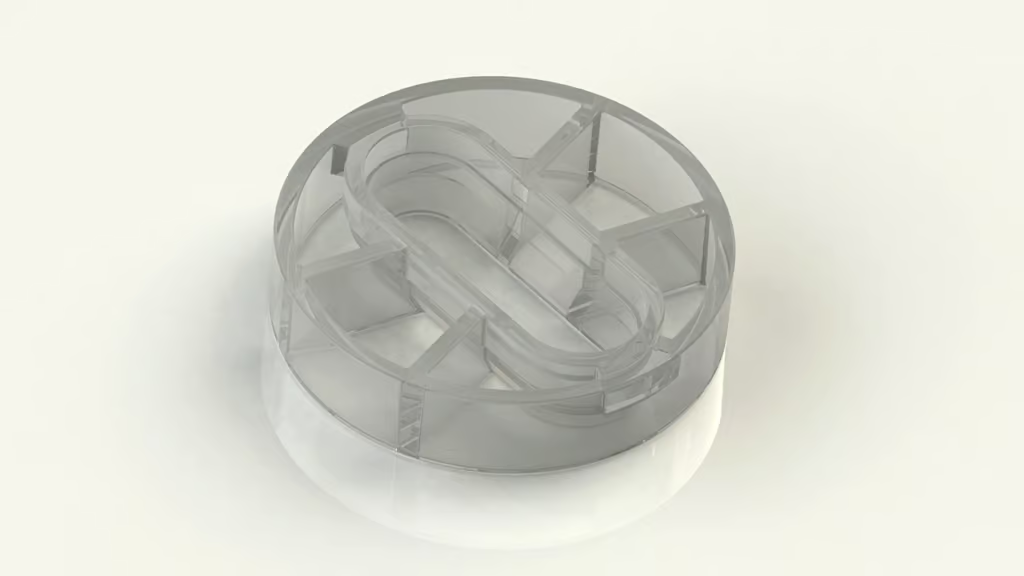
Thanks to the precise injection molding tools from the Formlabs 3D printer, the finished component could be produced more cost-effectively and in less time.
As a specialist dealer, the 3D-EDU GmbH team was on hand to provide advice during this development process:
“3D-EDU GmbH offers an excellent service in the area of application, as they themselves use the printers for customers and are therefore able to provide competent support with technical expertise. You can call them at any time and they will help and support you immediately.”
Today, thanks to the combination of additive manufacturing and injection molding, Fri-Plast is able to produce functional prototypes in the end material that meet the highest standards in the shortest possible time. At the same time, they are already in the process of using other materials such as ESD, Elastic 50A or Durable Resin for completely different applications.
We are proud to be working with such an innovative company and are already looking forward to the next exciting application from Fri-Plast.
Find out more details in the article from Formlabs:


