

Uncategorized
MakerBot LABS Extruder opens the MakerBot Method for third-party materials

May
MakerBot recently announced the availability of the MakerBot LABS experimental extruder for the MakerBot Method and Method X. This extruder turns the Method series into an open materials platform. This allows users to work with a variety of third-party materials on an industrial 3D printing platform. The first available extruders have already been sold. However, we will receive new supplies shortly.
MakerBot successfully launched a material development program in November 2019. In collaboration with leading filament manufacturers, the program offered the opportunity to qualify their materials for the MakerBot LABS extruder. The program has gained significant momentum since its announcement, and MakerBot has added leading material suppliers BASF 3D Printing Solutions and LEHVOSS Group to its growing list of partners, which also includes Jabil, Polymaker, Kimya and Mitsubishi Chemical.
We ourselves have also expanded our filament portfolio with third-party filaments. For example, we have added the relatively well-known filament manufacturer Formfutura, including DSM, to our portfolio. On the one hand, they impress with their inexpensive and high-quality filaments. On the other hand, we want to support their initiative towards cardboard spools. We have also included Treed filaments from Italy. In particular, they offer interesting high-performance filaments such as their PA 12 or “Hirma” PMMA filament, etc.
By opening the MakerBot Method and Method X to third-party filament, MakerBot is giving users an incredibly powerful tool to bring their ideas to life. Now you can print a virtually unlimited number of third-party engineering materials on an industrial 3D printing platform. Finally, the MakerBot Method Series is designed to produce stronger and more accurate parts than competing desktop 3D printers.
In addition, MakerBot has partnered with some of the best material companies to increasingly expand and diversify its own material portfolio for MakerBot Method. New, verified filaments from MakerBot will also be coming soon to open up new applications.
The new MakerBot LABS extruder allows users to experiment with new 3D printing materials. The industrial design of the MakerBot Method X is ideal for producing parts from high-performance materials that enable engineers to explore new 3D printing applications. With a build chamber that can currently be heated up to 110°C, the MakerBot Method X can produce parts that are stronger and more accurate than those printed on a desktop 3D printer with a heated build plate. With Stratasys’ soluble SR-30 support material and water-soluble PVA, complex geometries can be easily printed with engineering materials.
The new MakerBot LABS extruder has a modified hot end, which opens up new possibilities for the user. On the one hand, the MakerBot Print software gives you extended customization options and print settings for new materials. On the other hand, you get an exchangeable nozzle assembly, including nozzles. The new Labs extruder can reach temperatures of up to 300°C and has sensors that monitor temperature, materials and extruder jams.
The MakerBot LABS Experimental Extruder for METHOD is an experimental product and is not covered by the limited warranty or MakerCare.
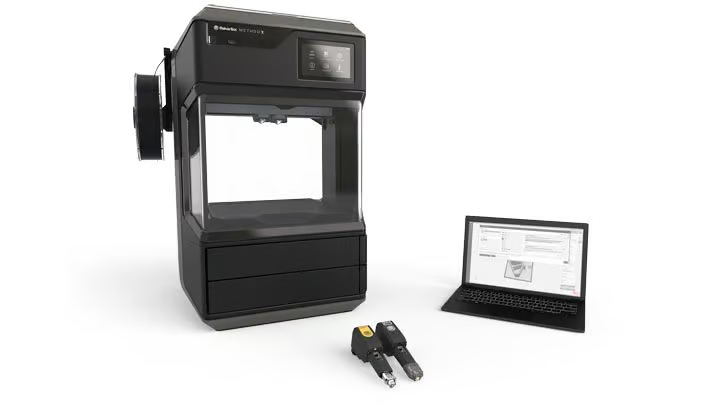
MakerBot is actively working with partners to qualify specific materials for the Method 3D printers. Recommended materials for the MakerBot LABS Experimental Extruder for METHOD include:
- Polymer Manufacturer PolyMax™ PC: Polycarbonate (PC) has excellent toughness, strength and heat resistance. PolyMax PC works well with the soluble SR-30 support material of the MakerBot Method X. This filament opens up new applications in the automotive, railroad and aerospace industries.
- Jabil PETg ESD: Jabil Engineered Materials PETg ESD is an easy-to-process electrostatic dissipative (ESD) product for printing parts that carry sensitive electronics and could be damaged by electrostatic discharge.
- Jabil TPE SEBS 1300 95A: This is a flexible material with a durometer of 95A that bends and stretches. It has proven its worth when printing complex geometries. Unlike other elastomers, SEBS 95A is insensitive to moisture and does not need to be dried.
- Kimya ABS-CARBON: This ABS composite material with 30% chopped carbon fibers has improved stiffness and compressive strength as well as a lower weight than normal ABS.
- Kimya PETG-KARBON: This is a PETG reinforced with carbon fibers for excellent stiffness and increased tensile strength compared to conventional PETG.
- Mitsubishi Chemical DURABIO™: DURABIO is a technical, bio-based, BPA-free plastic. It combines the transparency of PMMA with higher chemical and scratch resistance compared to polycarbonate (PC). The core applications for the material are in automotive, housing, interior and exterior decoration.
This variety of materials verified by MakerBot already shows the potential of the MakerBot Labs extruder for the MakerBot Method and Method X. From our own initial experience and testing, we know that many of the new materials we have introduced from Formfutura and Treed Filaments work just as well.
Due to the Covid-19 situation, MakerBot is currently offering a limited discount of around 30% on almost all 3D printers until the end of May. Among other things, this is intended to support companies that want to put professional 3D printing capabilities in the hands of their employees. As a MakerBot partner, we will of course pass this discount on to you.
MakerBot, METHOD, METHOD X and MakerBot Print are registered trademarks or trademarks of MakerBot Industries, LLC in the United States and/or other countries. SR-30 is a trademark of Stratasys, Inc. All other trademarks are the property of their respective owners.

