

Education Stories, School and education
3D printing & CAD at the vocational school in Uster

Aug
At the Uster Vocational School, three apprentices designed a catapult as teamwork in the free CAD prototyping course and then actually produced it using a MakerBot 3D printer.
A spontaneous idea from an apprentice to make a catapult quickly turned into a project for the free CAD prototyping course at the Uster Vocational School. He quickly found two fellow students who were willing to implement the project as a team.
After the first sketches of the basic structure, the first obstacle that had to be mastered appeared: How can the arm be accelerated?
After considering various proposed solutions, they agreed on the use of a spiral spring. In order to make efficient progress, they divided the project into different assemblies between them; while one had the challenging task of designing a coil spring and its assembly, the other took on the basic structure (outer side and arm) and the third in the group was responsible for the ball and stopper as well as for the entire pressure preparation.
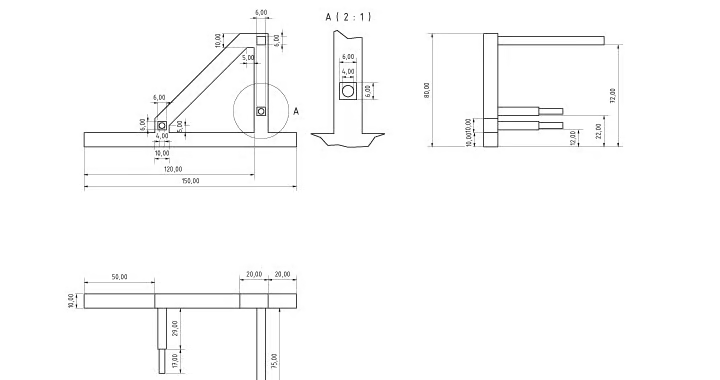
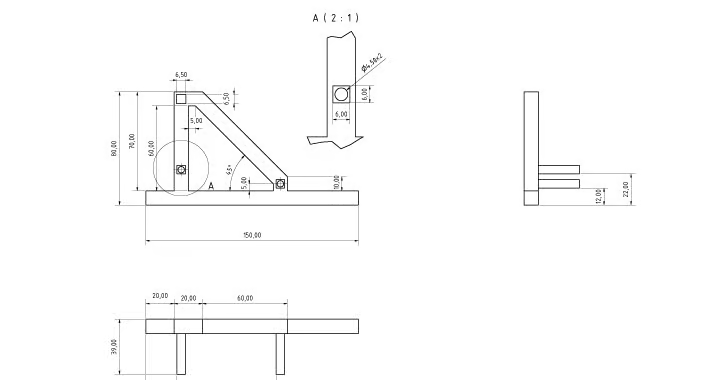
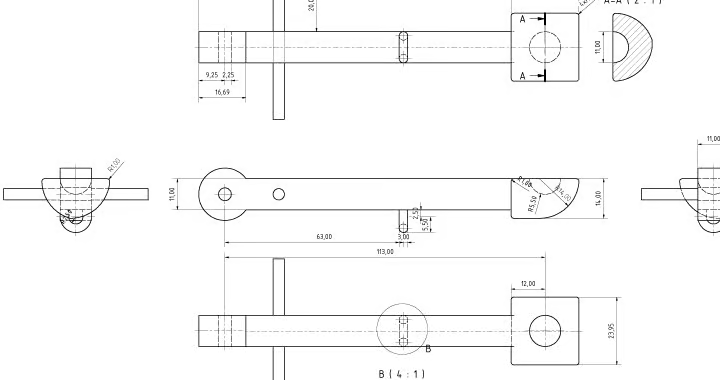
Up to 3 iterations of individual components were necessary; for example, various attempts had to be made to develop a spring with the appropriate tension.
According to the learners themselves, they got to know the Autodesk Inventor program better during the project. They also learned that good coordination is essential when dividing up the work or project, and that putting the individual assemblies together in Inventor allows potential problems to be identified before printing.
A good check before each printout with the MakerBot Desktop software allowed the printout to be made without any problems: “Since we planned our project precisely step by step from the start, we didn’t have any serious problems when printing.”
On the part of the teacher, it has been shown once again that the use of the 3D printer can significantly increase motivation. It also has the effect of awakening engineering in the sense of tinkering and inventing. In this way, what has been learned and designed in CAD can be implemented in reality in a tangible and verifiable way. The problem-solving process can also be learned and practiced through several iterations.

