

Medical
Formlabs Elastic Resin – 3D printing material that simulates silicone

Jan
The new Formlabs Elastic Resin is a very soft, yet very durable 3D printing material that simulates the properties of silicone.
We are now also pleased to present the Formlabs Elastic Resin in Switzerland. Another material in the range of Formlabs Engineering Resins for the Formlabs Form 2 SLA desktop 3D printer.
Elastic Resin is a bendable, stretchable and compressible material with a Shore hardness of 50A. In addition to high elongation, it has a high energy return. Elastic Resin components behave like silicone molded parts. The Formlabs Elastic Resin 3D printing material also simulates silicone in terms of its durability and tensile strength. This allows you to use components made from this elastic resin for multiple or periodic load cycles.

Flexible, silicone-like 3D printing materials that simulate elastomers
Flexible, silicone-like materials are often used in everyday objects, medical models or robotics. In many places where people come into contact with products or where moving parts are required, “soft materials” are used today. However, these silicone and urethane parts are currently often produced at great expense in mold making – even for prototypes.
A number of comparable 3D printing materials have been available in recent years. However, some of these materials can only be loaded in certain directions or can only withstand a few load cycles until they crack. They are often significantly harder and not even remotely comparable to silicone molded parts. This is no coincidence: the development of flexible 3D printing materials poses a challenge. On the one hand, the materials have to be as elastic as possible and yet sufficiently strong to be applied layer by layer. It is therefore necessary to combine two opposing properties.
Until now, the production of high-quality elastic components using the 3D printing process was only possible on expensive industrial 3D printers. Now this is also possible with inexpensive 3D printers such as the Formlabs Form 2. The basis for this development is the Formlabs Resin Tank LT. In combination with the Formlabs Elastic Resin, silicone-like components can now be produced in the shortest possible time in your own office or workshop.
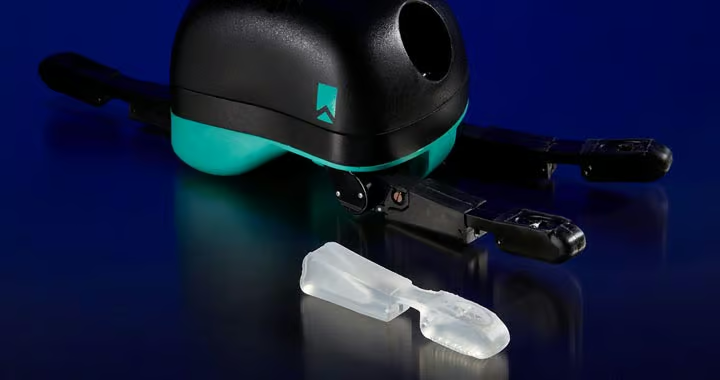
Silicone parts for product development available more quickly
For many companies, it is important to have silicone parts available quickly during the product development phase. Prior testing of components is often essential for the successful production of end products. 3D printing enables faster availability and thus reduces time and costs on the way to the end product.
Traditionally, mold making was used to produce silicone prototypes. Techniques such as RTV molding, injection molding or injection molding were used.
3D printing silicone parts with Formlabs Elastic Resin saves time, money and labor. This allows engineers and product designers to focus on their core business, which in turn leads to more iterations or shorter development cycles.
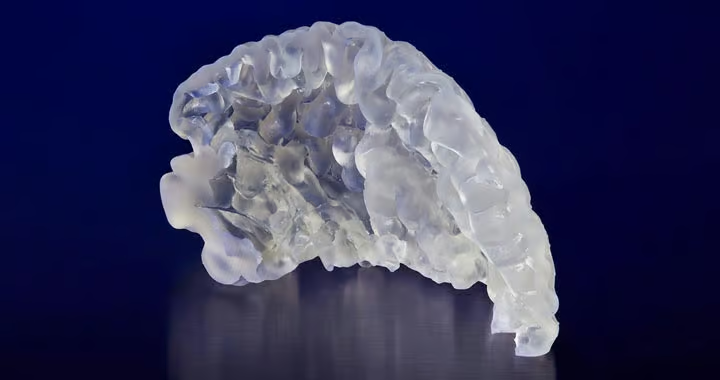
Soft and flexible medical models
Patient-specific anatomical models are increasingly being used by surgeons and radiologists for preoperative planning. These help them to prepare for complex interventions and operations. There is a high demand for models made of transparent, soft or flexible material. This is particularly desired in cardiac and neurosurgery, surgical oncology and other specialist areas. This is because tangible, patient-specific models not only allow precise preparation of the procedure, but can also improve communication within the surgical team and between doctors and patients.
With Formlabs Elastic Resin, Formlabs now enables the direct and inexpensive production of such elastic models for medical applications. Formlabs thus opens up access to models for training and preoperative planning for the entire medical industry and research.
Note: Printed parts made of Elastic Resin are not biocompatible.
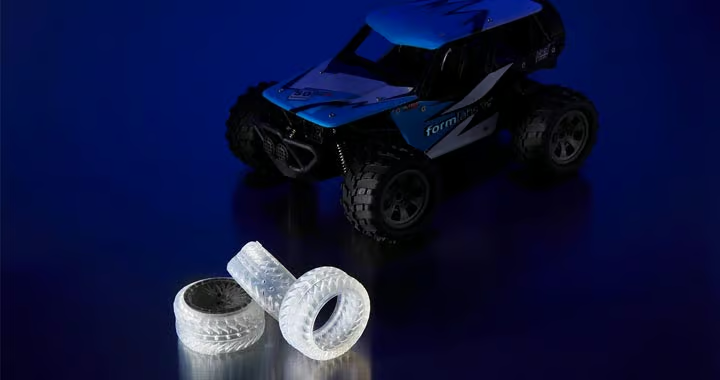
How do I design for Elastic Resin?
Although Formlabs Elastic Resin is just as easy to print as the other Formlabs materials, you should be aware of the following: Elastic materials for 3D printing require certain design rules to be followed on the one hand and on the other hand they require more support for printing than solid materials.
Contact us to learn how to prepare for printing with this material or read the article on the Formlabs support page.
If you are looking for a suitable 3D printing solution for your application, we will be happy to advise you. Get in touch with us!

