

Uncategorized
Formlabs Flame Retardant Resin – 3D printing in high-performance applications

May
We are delighted to announce the launch of the new Formlabs Flame Retardant Resin – the first self-extinguishing and UL 94 V-0 certified material for Formlabs SLA printers Form 3/B/L.
Especially for the transportation, aerospace, manufacturing, electronics and healthcare industries, the Flame Retardant Resin enables new applications such as:
- Small series of parts for aerospace, automotive and medical environments
- Tools and manufacturing aids for environments with high temperatures or proximity to ignition sources
- Electronics and connection housings or covers
- Electronic applications with high power (e.g. transformer coils and relays)
- Maintenance, repair and overhaul (MRO)
Now you can take advantage of the speed and design freedom of 3D printing while remaining compliant with regulatory requirements. Combined with Flame Retardant Resin, SLA technology offers a comprehensive solution for the design and manufacture of parts that require flame retardant properties in accordance with UL 94.
Order online now Contact us
Webinar
Learn all about Formlabs’ new UL94 V-0 certified flame-retardant resin, which allows you to easily 3D print self-extinguishing, heat-resistant, rigid and creep-resistant parts.
Language: German
View nowWhy flame-retardant 3D printing?
Combine the advantages of traditional manufacturing and 3D printing.
In industries such as aviation, electronics, medical technology and transportation, the requirement for flame-retardant parts is nothing new. In these environments, where sparks, ether or other combustibles are often present, strict regulatory monitoring is required to ensure the safety of workplaces and products. The standard certification for such disciplines is UL 94 – a flammability certification for plastics that determines the tendency of a material to either extinguish or spread a flame once it has ignited. Formlabs’ Flame Retardant Resin is Blue Card certified to UL 94 V-0, meets FAR 25.853(a) requirements for flame, smoke and toxicity testing, and can withstand hazardous environments with open flames, ignition sources and high temperatures.

Flame Retardant Resin is self-extinguishing as soon as the ignition source is removed.
Normally, plastics that can meet these standards are either machined, injection molded or cast. These processes often require expensive industrial equipment or hours of manual labor. Many companies outsource orders to machine shops or foundries, but face weeks-long lead times or high shipping costs. Traditionally, both outsourced and in-house operations are either expensive or inefficient and labor-intensive, making them ineligible for applications that require a UL 94 rating.
The development of some 3D printing materials has led to the availability of high-temperature resistant or flame-retardant materials, but there are also disadvantages. Although the filaments developed for FDM printing are UL-94 certified, they are not suitable for functional testing, end-use parts for presentation to customers or for use in maintenance and repair. Highly temperature-resistant 3D printing materials were already available for SLA 3D printing, but these were not UL-94-certified.

Parts made of Flame Retardant Resin (light gray) can be used as components in functional assemblies and withstand post-processing steps such as tapping, drilling and cutting.
Flame Retardant Resin combines all the benefits to enable high performance applications and certified safe workflows, all with the accessibility and performance of Formlabs’ SLA platform. After curing at 80°C for 120 minutes, Flame Retardant Resin parts have a heat deflection temperature (HDT) of 111°C at 0.45 MPa and a tensile modulus of 3.1 GPa. Other materials designed for high temperatures can be brittle, but flame retardant resin can be used as a component in a functional assembly and drilled for screw threads. The parts are rigid and creep resistant, making them reliable and durable in indoor and industrial environments. Unlike many FDM parts, Flame Retardant Resin has a smooth, matte finish with clean lines and high dimensional accuracy, making the parts suitable for end products or components in assemblies that require tight tolerances.
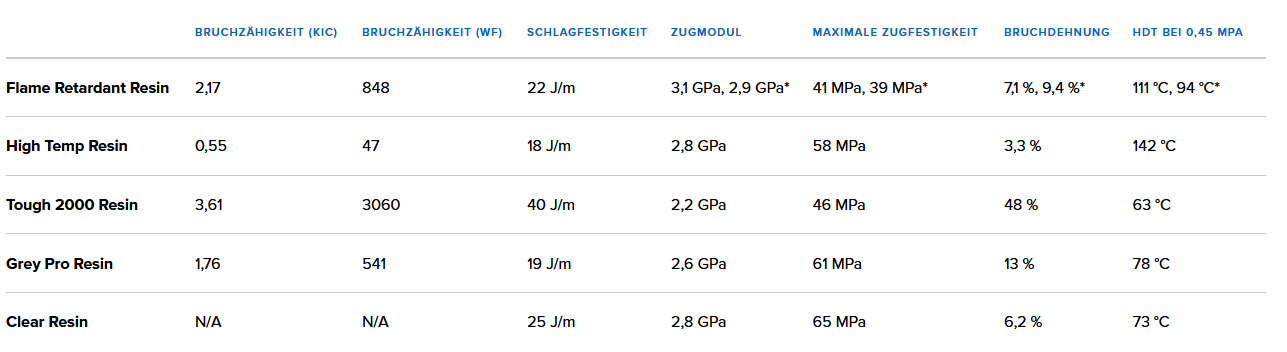
The technical data sheet illustrates the effects of the two curing options in the Form Cure. For the maximum heat resistance temperature of 111 °C at 0.45 MPa, post-cure the parts at 80 °C for 120 minutes. For applications that do not require the maximum heat resistance but benefit from higher toughness, cure the parts in the Form Cure at 70 °C for 60 minutes.
Opening up new applications and workflows
Industries such as aerospace and automotive are integrating 3D printing into their prototyping workflows, but need to switch to traditional manufacturing methods in the development phase to meet flammability requirements. With Flame Retardant Resin, you can not only shorten your development times, but also use a common material for all work steps, from design to maintenance and repair work to fixture manufacturing. With Flame Retardant Resin, SLA 3D printing can finally be used as an on-demand solution for the in-house production of repair parts.
By using scalable platforms such as the Form 3+ and Form 3L, you can increase the capacity of your 3D printer fleet without major investment and integrate a flame-retardant, self-extinguishing, tough and robust material into the entire work process that can be used in practical applications.

Flame-retardant parts open up new possibilities for 3D printing in the transportation, aviation, manufacturing, electronics and aerospace industries.
Get started with 3D printing flame-retardant parts
Entry into the 3D printing of flame-retardant parts
In highly regulated industries where safety is paramount, 3D printing has already optimized the iterative design cycle and enabled innovation through geometric freedom and affordable production tools.
Flame Retardant Resin removes some of the stumbling blocks that product designers have faced when moving from visually appealing models to functional testing or low-volume final products. With the certifications required for use in manufacturing, aerospace, automotive and electronics industries, Flame Retardant Resin streamlines workflows and helps shorten the iterative cycle.
Contact us to find out more about the material properties and to request a sample print.


